We interrupt your waiting for news about Guatemalan adoption reform to draw your attention to domestic adoption reform here in the U.S. The blogosphere has been buzzing this week, and an adoptee rights bill is in the Massachusetts State Senate.
Some of you asked us why we didn't choose to adopt domestically. There were many reasons behind that decision, but in this context I want to discuss a couple of them. We felt uncomfortable that the domestic adoption process in this country 1) allows first mothers to finalize the relinquishment way too early (some states require only a 24 hour waiting period, by which time the drugs haven't worn off, the hormones are nowhere near evening out, and she hasn't really had a chance to try to parent this child; in Guatemala the first mother is required to sign off 3 times over a period of months), and 2) first mothers choose the adoptive parents BEFORE the birth of the child. This second point sounds very cute and fuzzy and sweet, but although I support the first mother's decision to choose the adoptive family I do not think they should be choosing before birth. I have heard the stories of multiple first mothers for whom their love and respect for the adoptive parents pushed them to place rather than to parent. When they wavered, they couldn't bear to disappoint the wonderful people who were hoping so much for their baby--and the child left a home that could have raised it, and the adoptive family was filled with a child that didn't need their home.
What would a better system look like? A good example is Australia's, in which the emphasis is upon parenting before placing, and a lot fewer babies end up needing new homes. Here's an excellent post by paragraphein about how the specifics of a revamped U.S. domestic adoption system could work. I'm all for it.
Since the entrance of Gus into all of our lives, I've become much more activist about the rights of all people involved in adoption, especially the adoptees. Adoptees are so very vulnerable; they aren't consulted about the family they want to be part of, and they often lack advocates until they have been adopted. I'd like to encourage you to help advocate for the well-being of these children and the adults they grow into: another great post by paragraphein gives some suggestions for becoming an advocate with varying degrees of time to give and further details on the problems with the current system, an excellent blog by seriously details her experience fighting for a truly ethical domestic adoption (including a blessedly failed placement), and this site discusses legislation which may be pending in your area.
The adoption process in our own country scared us. How sad. Let's help make our process an example to the world in how it prioritizes the best interests of the children, protects the birth parents, and supports the adoptive parents.
O'Donnell Olio
olio
\ˈō-lē-ˌō\
- Olla Podrida
- a miscellaneous mixture : hodgepodge
- a miscellaneous collection (as of literary or musical selections)
Saturday, March 24, 2007

Friday, February 16, 2007
An Exciting Day
Today we got a very exciting email from our social worker. It said that not only are we out of Family Court, we were submitted to the Attorney General's office (PGN) on January 17, and have already been kicked out! Kick-outs are part of the routine from the PGN; most families have two or three kick-outs. Ours was because the pre-approval hadn't come from the US Embassy yet (it should soon, since the DNA has been completed), and because the last name on the baby's birth certificate doesn't exactly match the last name on the mother's birth certificate (it's a difference of a tilde). So we're waiting for pre-approval, and the attorneys are working on a resolution of the tilde issue. Yes, we think it's funny too.
What's most exciting is that we've already been in PGN for a month, and had our first kick-out without even knowing it. The Guatemalan political situation is, as always, a little weird and unpredictable, but we may be looking at around 3 months until baby instead of around 6. Of course, no guarantees. But I'm starting to get excited on the inside, and my sister (who has two munchkins) is helping me figure out what non-furniture baby things we need.
We also got a medical update (but no pictures). He's doing great!
And lastly, since the Family Court process has been completed, we're feeling reasonably sure that this baby is our baby. Although we're keeping his full name a secret for a while longer, he doesn't need to be Ronald in public anymore. Now y'all can call him the nickname we've been calling him, privately and hopefully, within 24 hours of his referral: his name is Gus.
What's most exciting is that we've already been in PGN for a month, and had our first kick-out without even knowing it. The Guatemalan political situation is, as always, a little weird and unpredictable, but we may be looking at around 3 months until baby instead of around 6. Of course, no guarantees. But I'm starting to get excited on the inside, and my sister (who has two munchkins) is helping me figure out what non-furniture baby things we need.
We also got a medical update (but no pictures). He's doing great!
And lastly, since the Family Court process has been completed, we're feeling reasonably sure that this baby is our baby. Although we're keeping his full name a secret for a while longer, he doesn't need to be Ronald in public anymore. Now y'all can call him the nickname we've been calling him, privately and hopefully, within 24 hours of his referral: his name is Gus.
Sunday, February 11, 2007
Crib installed

The baby's room is now fully furnished. Last weekend we acquired and installed a crib in the baby's room. We got it from a co-worker of Rebekah's whose daughter just outgrew it. We also finished and moved in the toy bin (trying and not succeeding to use up the extra paint left over from painting the dresser--we're used to painting rooms, so we way overestimated how much paint we would need). After all the furniture was moved in, we promptly rearranged every piece, but we think we're happy with the arrangement now.
Note the crib's feet. The crib didn't start with any shoes of its own, but these shoes have been waiting for it for years, a gift from friends when we first started telling people that we were going to adopt.
Wednesday, January 17, 2007
Baby room update 2
 In the end, we decided not to stain the dresser after all. Instead, we painted it, as you can see to the right. It turned out pretty well. The semi-gloss paint makes the knobs really pop.
Also, as you can see, we received and installed the foam tiles to cover the floor. Hopefully fewer tears will be shed when he starts to learn to walk.
Friday, December 29, 2006
Baby room update
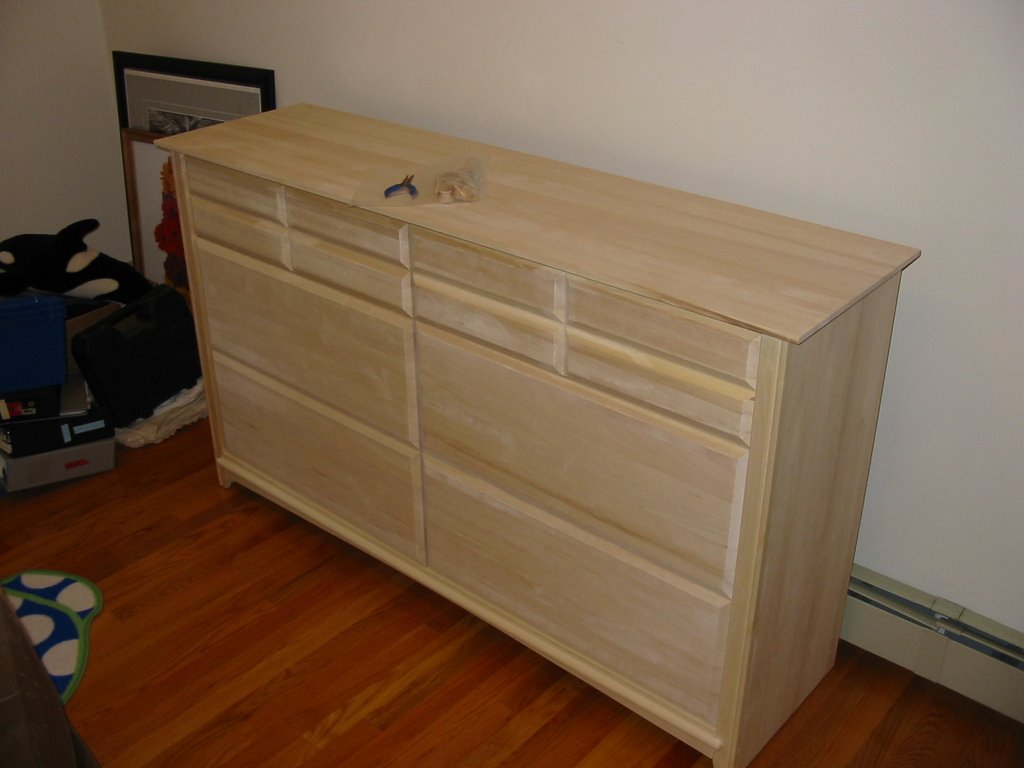 Happy New Year, dear reader. We don't have any real news today, except to brag about our sweet new enormous dresser for the baby's room (show of hands: who is now officially sick of hearing people describe things as ginormous? The zeitgeist really spat that one in our faces this year, didn't it? In 2007, let's turn it around and start using egantic.)
There it is, to the right. We took advantage of a mad end-of-year clearance sale at Millstores, a really nice unfinished furniture store in Malden, MA. 40% off for a nice solid dresser. The knobs are sitting on top, but I'm not all that thrilled about the knobs that were included. We may look into some alternatives. I also have to sand down some of the sharp edges and stain and seal it. Not sure how dark a stain we should go for, if any. Any suggestions from the readership? The floor and wall are in the shot.
Other exciting baby room progress: we've ordered 100 square feet of foam tiles to cover the floor with for playing/crawling/falling down purposes. This weekend we're going rocker/glider shopping. I know certain parties are interested in seeing more room updates, so I'll keep posting them. Thanks to the rest of you for indulging us.
Monday, November 20, 2006
Referral!
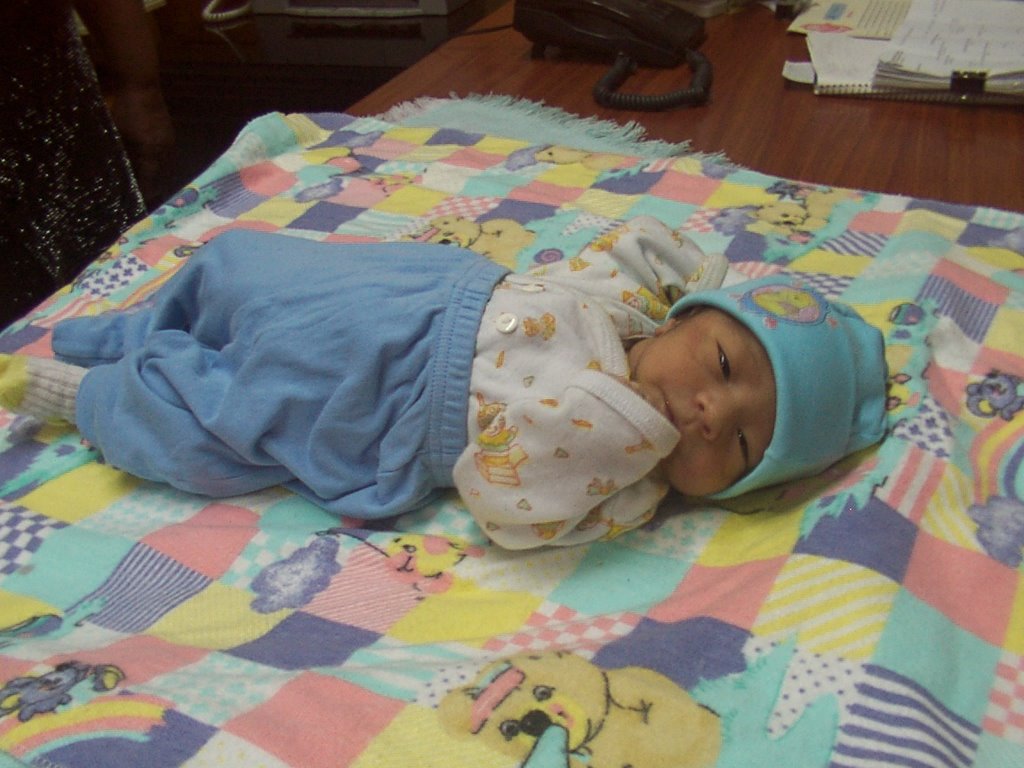 It's been less than three weeks since the national office received our completed dossier. But on Sunday we opened an email from Pam announcing our referral of a baby boy. Wow!
He was born on November 5. He weighs 6 pounds (American babies are enormous compared to some other countries) and is 19.3 inches long. He's already in foster care and under the supervision of a pediatrician.
A caution: we can't be sure yet that this baby is our Ronald. International adoption is not predictable. We're trying to wait until the DNA test, a few months from now, to give our hearts to this baby. (DNA test ensures that the woman making an adoption plan for the child is indeed his birthmother; she will also reaffirm her decision to make that plan at the time of the test.) Until then, we'll call him "Ronald" but we mean "Ronald?". But he's cute. More pictures are posted on our picture-sharing website--if you don't have the address, email us and we'll send it to you.
Up next: tomorrow we bring his pictures and medical report to the International Adoption program at Children's Hospital for review by their doctor. As long as there are no surprises, we plan to accept the referral. More paperwork, notarization, and state seals. After that our documents will be translated and sent to Guatemala. It takes a while to move into the system, so we probably won't officially enter Family Court, the next big step, for about three months.
Saturday, November 11, 2006
An Ethical Adoption
Some of you may have read a recent article in the New York Times which must have been pretty upsetting to everyone who read it. As an adoptive parent-in-waiting, it was particularly upsetting to me in the way it implied that most adoptions of Guatemalan children are unethical.
I was disappointed in the Times; to start with, the reporter didn't do basic fact-checks which put his other conclusions at serious risk. The easiest whoops, which the Times has now corrected online, stated that the current President Berger signed the Hague Convention on Intercountry Adoptions in 2002, when it was actually President Portillo. More damaging was the statement that "after years of legal challenges the nation’s Constitutional Court ruled definitively this year that the country must abide by it." That's just not true. The Guatemalan Constitutional Court had previously ruled that President Portillo's accession to the treaty was unconstitutional; their recent ruling says that regardless of the unconstitutionality, the current President cannot be forced to withdraw from the treaty. It's a complicated impasse, but should not have been papered over with that definitive but incorrect statement.
Why does the Hague treaty matter to Guatemalan adoption anyway? The Hague treaty does seem to want to help children. Unfortunately it has the same downside as another piece of well-known legislation that wanted to help children: the No Child Left Behind legislation. Both are unfunded mandates, meaning that significant rules are instituted with no additional funding to institute them. The Hague would require the government to take over all adoptions, but children in Guatemala whose families cannot take care of them do not go into foster care unless they are given into the care of a private attorney for international adoption. They grow up in orphanages and then are on their own at 18. The Hague would also strongly encourage domestic adoption options for all children to be exhausted before the children would be available for international adoption. But in Guatemala, domestic adoption is extremely rare because of cultural traditions, and holding every child for the rare domestic adoption would mean that the vast majority of children would spend more years in an orphanage.
A study released today on children in orphanages and adopted from orphanages in Romania showed that adoption increased the health and IQ of the children, especially when they were adopted before age 2. Anti-international adoption groups are already assailing the study, correctly assuming that it will be used to pressure countries to reopen international adoptions. Some people think that preserving the culture of the children is of paramount importance--this study shows clearly that with that goal they are sacrificing the health of the children. Therefore, implementing the Hague treaty in Guatemala (if the impasse is somehow solved) will very likely have unfortunate deleterious side effects on a large number of children.
The major theme of the Times story was baby-buying, and told a story of an unscrupulous attorney giving money to a birth mother in exchange for her baby so that the child could be adopted internationally. That story should be upsetting. I do not doubt that some attorneys and agencies are corrupt, or that some adoptive parents are desperate, clueless, or careless enough to accept the referral of any child. But responsible adoptive parents should choose their agency carefully. We did serious homework before we chose, and our agency has a long history of ethical international adoption. They continue to work in countries where the international adoptions have been closed, for the sake of the children, and they are non-profit. They run background and reference checks on their attorneys, and those attorneys are responsible to direct supervisors in Guatemala and the U.S. supervisors who frequently travel there.
This whole post means: we are neither desperate nor clueless, and we do care very much that our adoption is conducted in an ethical fashion. It was insulting to us and to many other ethical adoptive parents, agencies, attorneys, and notaries for the Times to publish such an inflammatory article which suggests that an ethical adoption from Guatemala is not possible. However, these articles seem to come out about every six months. Consider them rebutted. We have done our homework, we are behaving responsibly, and our Ronald will NOT have been bought.
I was disappointed in the Times; to start with, the reporter didn't do basic fact-checks which put his other conclusions at serious risk. The easiest whoops, which the Times has now corrected online, stated that the current President Berger signed the Hague Convention on Intercountry Adoptions in 2002, when it was actually President Portillo. More damaging was the statement that "after years of legal challenges the nation’s Constitutional Court ruled definitively this year that the country must abide by it." That's just not true. The Guatemalan Constitutional Court had previously ruled that President Portillo's accession to the treaty was unconstitutional; their recent ruling says that regardless of the unconstitutionality, the current President cannot be forced to withdraw from the treaty. It's a complicated impasse, but should not have been papered over with that definitive but incorrect statement.
Why does the Hague treaty matter to Guatemalan adoption anyway? The Hague treaty does seem to want to help children. Unfortunately it has the same downside as another piece of well-known legislation that wanted to help children: the No Child Left Behind legislation. Both are unfunded mandates, meaning that significant rules are instituted with no additional funding to institute them. The Hague would require the government to take over all adoptions, but children in Guatemala whose families cannot take care of them do not go into foster care unless they are given into the care of a private attorney for international adoption. They grow up in orphanages and then are on their own at 18. The Hague would also strongly encourage domestic adoption options for all children to be exhausted before the children would be available for international adoption. But in Guatemala, domestic adoption is extremely rare because of cultural traditions, and holding every child for the rare domestic adoption would mean that the vast majority of children would spend more years in an orphanage.
A study released today on children in orphanages and adopted from orphanages in Romania showed that adoption increased the health and IQ of the children, especially when they were adopted before age 2. Anti-international adoption groups are already assailing the study, correctly assuming that it will be used to pressure countries to reopen international adoptions. Some people think that preserving the culture of the children is of paramount importance--this study shows clearly that with that goal they are sacrificing the health of the children. Therefore, implementing the Hague treaty in Guatemala (if the impasse is somehow solved) will very likely have unfortunate deleterious side effects on a large number of children.
The major theme of the Times story was baby-buying, and told a story of an unscrupulous attorney giving money to a birth mother in exchange for her baby so that the child could be adopted internationally. That story should be upsetting. I do not doubt that some attorneys and agencies are corrupt, or that some adoptive parents are desperate, clueless, or careless enough to accept the referral of any child. But responsible adoptive parents should choose their agency carefully. We did serious homework before we chose, and our agency has a long history of ethical international adoption. They continue to work in countries where the international adoptions have been closed, for the sake of the children, and they are non-profit. They run background and reference checks on their attorneys, and those attorneys are responsible to direct supervisors in Guatemala and the U.S. supervisors who frequently travel there.
This whole post means: we are neither desperate nor clueless, and we do care very much that our adoption is conducted in an ethical fashion. It was insulting to us and to many other ethical adoptive parents, agencies, attorneys, and notaries for the Times to publish such an inflammatory article which suggests that an ethical adoption from Guatemala is not possible. However, these articles seem to come out about every six months. Consider them rebutted. We have done our homework, we are behaving responsibly, and our Ronald will NOT have been bought.
Subscribe to:
Posts (Atom)